

Selecting the best countertop for bathroom renovations requires balancing daily utility with moisture control and visual design. Bathrooms present specific challenges that kitchens do not. High humidity levels, continuous contact with standing water, cosmetics, and heated hair tools all test surface durability every day.
A vanity surface must resist staining from toothpaste, acetone, and hair dyes while resisting mold and mildew growth around sink cutouts. Whether you are updating a compact powder room or building a custom double vanity for a primary suite, choosing the correct slab sets the tone for your entire space.
How to choose the best material for a bathroom vanity top
Finding the best material for bathroom vanity top installations involves evaluating structural, environmental, and financial factors before purchasing a slab. Bathrooms endure rapid temperature shifts and exposure to harsh personal care chemicals, so choosing strictly based on appearance often causes premature surface damage.
Follow this 5 step process to narrow your decision:
- Identify the room traffic and primary user profile. High traffic family bathrooms and guest powder rooms experience entirely different demands. Family spaces need impact resistance against dropped items and chemical resistance against colorful hygiene products. Powder rooms focus primarily on guest presentation and allow delicate decorative stones.
- Evaluate maintenance capacity and willingness to seal stone. Porous surfaces demand annual or biannual liquid impregnating sealers to prevent water absorption. Nonporous engineered materials need zero periodic sealing, requiring only mild soap and warm water for sanitation.
- Calculate realistic total project budgets by square footage. Total price involves more than raw slab costs. Factor in fabrication fees, undermount sink cutouts, faucet hole drilling, backsplashes, and professional installation. Typical vanities run from 12 sq ft to 30 sq ft in total area.
- Review sink styles and plumbing rough ins. Heavy cast iron drop in sinks work well with almost any rigid substrate. Undermount sinks require dense, water impervious materials like solid stone or engineered slabs to protect exposed edge profiles from water intrusion.
- Account for heated styling tools and liquid chemical spills. If styling tools resting at 400 °F touch the deck daily, natural granite, quartzite, or porcelain outperform resin bound engineered stones. If nail polish remover or exfoliating acids are common, avoid acid sensitive calcium carbonate stones like marble.
Top bathroom countertop materials compared
Fabricators work with several distinct bathroom countertop materials, each engineered by nature or modern industrial processes to address specific structural needs. Understanding the mineral composition and mechanical properties of each option helps you choose the right fit for your layout.
Quartz Countertops
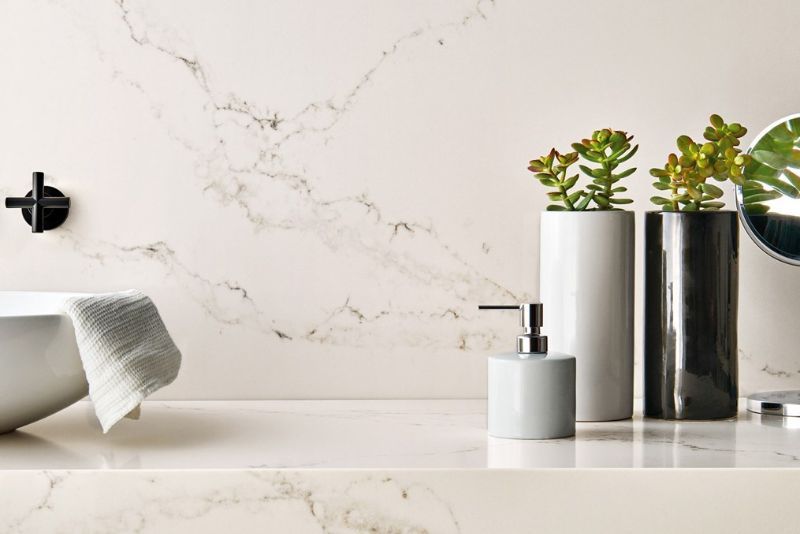
Quartz combines 90% to 93% ground natural quartz with polymer resins and pigments. This creates a nonporous slab with a 0.05% absorption rate, making it impervious to water and bathroom liquids without requiring sealers. Clean with mild soap and water. Available in numerous styles, including realistic marble replicas. Its primary limitation is thermal tolerance; resins can scorch or crack above 300°F, requiring heat pads for styling tools. Prices range from $60 to $130 per sq ft installed.
Granite Countertops
Granite is an igneous rock primarily composed of quartz, feldspar, and mica, ranking 6 to 7 on the Mohs scale. Each naturally crystallized slab features unique patterns. It strongly resists scratches and withstands styling tools exceeding 450°F without discoloration. However, its microscopic pores absorb moisture if unsealed, potentially harboring bacteria or stains. Applying a penetrating sealer every 12 to 24 months is required. It is an excellent choice for raw beauty and heavy-duty durability. For homeowners seeking raw natural beauty paired with heavy duty durability, granite is the best material for bathroom countertops. Installed costs average $50 to $120 per sq ft.
Marble Countertops
Formed from metamorphosed limestone, marble consists of crystalline calcium carbonate, offering luminous depth and classic veining like Carrara. It stays naturally cool and handles high moisture and hot styling tools without scorching. Its main drawback is chemical vulnerability; acidic substances like citrus, vinegar, or astringents rapidly cause dull etching. It also scratches relatively easily (Mohs 3 to 4). A honed matte finish is often chosen over high gloss to better hide these imperfections. Marble costs $75 to $200 per sq ft installed.
Quartzite Countertops
Quartzite is a natural metamorphic rock formed from pure quartz sandstone under extreme heat and pressure. It provides the elegant veining of marble but boasts a Mohs hardness of 7, outperforming granite. It resists acidic bathroom liquids and easily handles hot curling irons. However, its porous capillaries require sealing before use and annually thereafter. Its extreme density requires specialized cutting, increasing fabrication labor costs. It is ideal for marble aesthetics without acid sensitivity. Fully installed pricing ranges from $80 to $210 per sq ft.
Solid Surface Countertops
Solid surface materials blend natural bauxite minerals with acrylic or polyester resins, forming a uniform, nonporous slab. Its main advantage is invisible, chemically bonded seams, allowing for integrated, seamless acrylic sink bowls that eliminate mold-prone caulked crevices. It resists moisture, bacteria, and stains without sealing. While it scratches and scorches under heat, damage can be easily buffed out with fine abrasive pads rather than replacing the slab. Expect costs between $45 and $95 per sq ft installed.
Porcelain Countertops
Fired above 2200°F, porcelain (sintered stone) is composed of clays, feldspar, and silica. This vitrification creates a rigid slab with under 0.01% water absorption, offering total resistance to chemicals, hot styling tools, and UV light. High-resolution inkjet technology prints realistic stone or metal patterns onto the surface. Porcelain is the best bathroom countertop material for installations requiring total resistance to both chemicals and heat.
Because slabs are exceptionally thin (6 mm or 12 mm), they require reinforced substrates or mitered edges and specialized fabricators to prevent chipping during installation. Installed prices run from $65 to $140 per sq ft.
Laminate Countertops
Laminate layers resin-saturated kraft paper with a printed decorative layer and a melamine wear layer over a particleboard core. It offers the lowest price point, with modern printing closely replicating wood or stone. While the surface resists daily soap and water, the wood substrate is highly vulnerable to moisture. Seeping water causes irreversible swelling and delamination. It scratches easily and melts under hot styling tools, making it best for budget updates or dry powder rooms. Costs range from $25 to $55 per sq ft installed.
Quick comparison matrix: best bathroom countertop options
Comparing physical attributes side by side simplifies selecting among varied bathroom countertop options for your vanity project.
Every material presents unique engineering tradeoffs. High durability and low maintenance often balance against maximum heat limits or upfront investment costs.
What is the overall best countertop material for your bathroom?
When weighing mechanical performance, aesthetic versatility, daily cleaning requirements, and total cost, quartz is the overall best countertop material for bathroom remodels.
Quartz eliminates the recurring sealing chores required by natural stone slabs. Because bathroom environments contain persistent water splashes, high relative humidity, and hygiene chemicals, nonporous quartz keeps moisture on the surface where it wipes away clean.
Quartz handles daily bathroom realities better than any rival material:
- It will not harbor mold, bacteria, or mildew around faucet holes.
- It resists discoloration from liquid foundation, bright lipstick, hair dyes, mouthwash, and shaving cream.
- It offers structural strength that resists chipping along eased or bevel vanity edges.
- It replicates luxury marble patterns without vulnerability to acid etching.
For primary suites where adults routinely set down heated styling tools, granite or quartzite serve as superior alternatives due to their higher heat tolerances. For children's bathrooms and high usage guest baths, quartz remains the most reliable option for long term performance.
Essential maintenance tips for bathroom vanity tops
Proper cleaning techniques preserve the factory finish and structural integrity of even the best bathroom countertops. Harsh chemicals, abrasive scrubbers, and neglected water pools can degrade protective sealers and etch natural minerals over time.
Keep your vanity top pristine with these practical guidelines:
- Wipe away standing water around faucet escutcheons, sink rims, and soap dispensers daily to prevent hard water mineral buildup.
- Clean surfaces with warm water, mild liquid dish soap, and soft microfiber cloths rather than acidic, abrasive, or ammonia based cleaners.
- Avoid setting high heat styling tools directly on stone or engineered tops; always use heat resistant silicone mats or countertop styling stands.
- Test natural stone sealers every 6 to 12 months by placing 3 drops of water on the surface; if the water darkens the stone within 5 min, apply a new coat of penetrating stone sealer.
- Clean up nail polish remover, hair dye, liquid bleaches, and facial exfoliants immediately to prevent surface etching or discoloration.
- Do not stand, sit, or place heavy ladders on vanity overhangs, as cantilevered stone corners can crack under concentrated point loads.


