

Upgrading your kitchen surfaces always brings you to a direct standoff between engineered stone and natural rock. Homeowners planning a kitchen remodel look closely at the cost of quartz vs granite to decide which surface delivers better value without wrecking their renovation budget. Both surfaces offer durability, premium aesthetics, and long working lifespans, yet their pricing structures behave very differently from the quarry or factory to final placement.
Granite is quarried directly from the earth in massive blocks, sliced into slabs, and polished. Quartz is an engineered product composed of roughly 90% to 93% crushed natural quartz crystals bound with 7% to 10% polymer resins and color pigments. Because 1 material comes from global geological deposits and the other comes from advanced manufacturing facilities, their raw material pricing, fabrication requirements, and labor expenses vary. Understanding these differences helps you allocate your renovation dollars effectively.
Which is more expensive, quartz or granite?
When you ask which is more expensive quartz or granite, the answer depends on the quality tier you select. Standard granite starts lower, costing $40 to $60 per sq ft installed, compared to $55 to $65 for entry-level quartz.
At the high end, the price dynamic flips. Exotic granite can exceed $150 to $200 per sq ft installed due to rarity and shipping. Premium quartz tops out around $120 to $150 per sq ft installed.
Granite presents a wider price spectrum overall: low-tier granite is generally cheaper than low-tier quartz, while luxury granite is usually more expensive than top-grade quartz.
Detailed cost breakdown: quartz vs. granite price
To accurately evaluate the quartz vs granite price, you must separate what you pay for the raw stone from what you pay for digital templating, edge shaping, cutouts, and skilled crew labor. Many homeowners focus solely on sticker prices per sq ft without accounting for these secondary expenses.
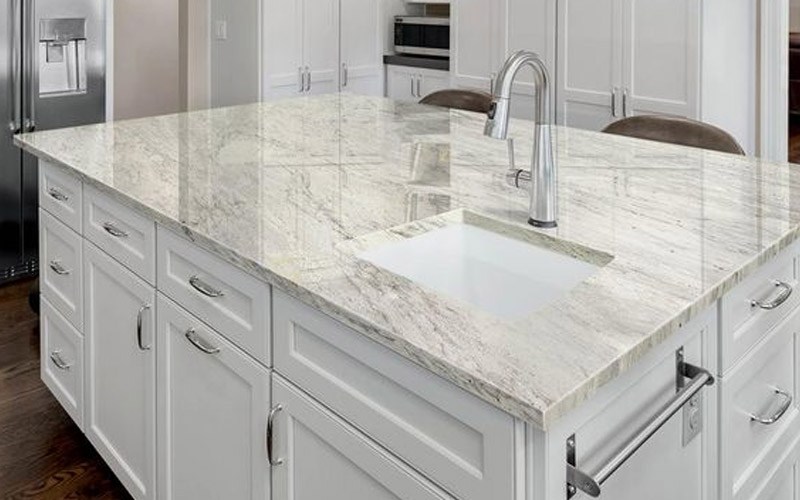
Material costs
Material pricing is driven by grading, origin, thickness, and manufacturing complexity.
Natural stone suppliers sort granite into 3 to 5 grades based on structural integrity, mineral rarity, color, and movement. Grade 1 (entry-grade) granite features common patterns cut to 2 cm or 3 cm thickness, keeping raw costs down to $20 to $40 per sq ft. Grades 3 to 5 offer rare colors and dramatic veining, but carry higher extraction risks and transoceanic shipping fees.
Quartz pricing operates differently because it is engineered. Quality grades depend on brand, crystal purity, pigment complexity, and resin market costs. Basic monochromatic slabs require simpler production and cost less. Premium brands like Omega Surfaces, Cambria, and Silestone create complex multi-tonal slabs with full-depth veining using specialized robotic pressing technology.
Is quartz cheaper than granite? For basic colors, no; basic granite slabs remain cheaper than basic quartz.
Installation and fabrication costs
Fabrication and installation represent 40% to 60% of your total project invoice. Both materials are extremely dense and heavy, averaging 18 to 22 lbs per sq ft for 3 cm thickness. This requires specialized diamond tooling, water jets, CNC routing tables, and 2 to 3 trained installers to set the pieces.
Fabrication expenses vary based on project layout and customization:
- Straight edge profiles like eased, bevel, and half-bullnose are included in base estimates.
- Complex profiles such as full bullnose, ogee, and dupont add $15 to $35 per linear ft.
- Undermount sink cutouts require internal edge polishing, adding $150 to $300 per opening.
- Drop-in cooktop, faucet, and electrical cutouts range from $25 to $75 per penetration.
- Digital laser templating runs $150 to $300 to map existing cabinet walls and framing.
Granite requires extra care during fabrication because hidden internal fissures can crack under high-speed blades, requiring slower cutting speeds and reinforced sink rails. Quartz behaves more consistently without natural fissures, but generates hazardous crystalline silica dust requiring mandatory wet-cutting protocols. Overall, standard installation labor costs remain comparable between both materials, averaging $30 to $60 per sq ft.
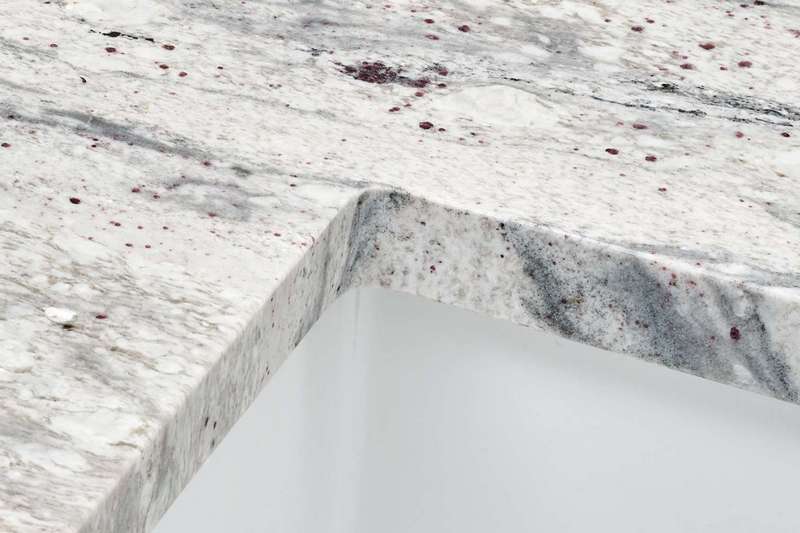
Pros and cons of quartz and granite (Price vs. value)
Evaluating which is cheaper granite or quartz involves looking past your initial installation invoice to calculate maintenance requirements, longevity, and everyday performance. A material that costs less initially can end up costing more over a 15-year period if it requires regular professional care or sustains irreversible surface damage.
Quartz countertops
Quartz offers distinct functional advantages for modern households, but it also carries operational limitations that every homeowner should know.
Pros:
- Non-porous surface: The resin matrix seals the mineral structure entirely, eliminating the need for sealants, waxes, or special conditioning treatments.
- Stain resistance: Everyday liquids like coffee, red wine, olive oil, lemon juice, and dark vinegar cannot penetrate the surface.
- Color and pattern consistency: Slabs match showroom samples reliably, which makes seam matching across long runs or wide islands predictable.
- Low day-to-day upkeep: Cleans effectively with warm water and mild dish soap; eliminates the need for stone-specific pH-neutral cleaners.
- Structural flexibility: The resin binder gives quartz higher tensile strength than natural stone, making it less prone to cracking or chipping around rim edges.
Cons:
- Heat vulnerability: The binding resins withstand temperatures only up to 150 °F to 300 °F. Direct contact with hot cookware straight from a burner or oven can cause permanent yellowing, resin melting, or thermal shock fractures.
- Indoor use only: Prolonged exposure to direct UV rays breaks down the polymers, leading to fading, discoloration, and surface warping.
- Higher base price: You cannot find deep-discount quartz comparable to bargain-tier commercial granite.
From a value perspective, quartz delivers a zero-maintenance ownership experience. Over a 10-year span, you spend $0 on sealers and avoid professional stain extraction treatments, which bridges the initial price gap for busy households.
Granite countertops
Granite remains the gold standard for natural stone enthusiasts who value organic beauty, thermal resilience, and individual slab character.
Pros:
- Exceptional heat resistance: Formed under extreme subterranean pressure and heat, granite easily withstands direct contact with hot pans up to 450°F or higher without scorching.
- 100% natural aesthetics: No 2 slabs are identical; each piece features distinct swirls, mineral deposits, flecks, and depth that synthetic printing cannot duplicate.
- UV and weather resistance: Unaffected by direct sunlight, making it the premier choice for outdoor kitchens, patio bar tops, and sunny window bays.
- Repairability: Surface chips along edges can be filled with color-matched epoxy and buffed flush; dull spots can be professionally repolished on-site.
- Long-term durability: Highly scratch resistant against kitchen knives, though cutting directly on granite will dull your cutlery blades quickly.
Cons:
- Porosity: Natural capillaries allow liquids to soak into unsealed stone, leading to dark water marks, oil saturation, and bacterial harboring.
- Ongoing maintenance required: Slabs must be treated with a penetrating impregnator sealer every 1 to 2 years, costing time and $15 to $40 per bottle.
- Inconsistent slab patterns: Veining and color variations make matching seams between adjacent slabs challenging; requires layout planning at the fabrication shop.
- Brittle composition: Naturally occurring fissures and dry veins create structural weak points that can crack if cabinets settle unevenly.
Over 15 to 20 years, granite provides unmatched material resilience. If properly sealed, it will outlast cabinetry and appliances without showing wear, making it a reliable investment for long-term homeowners.
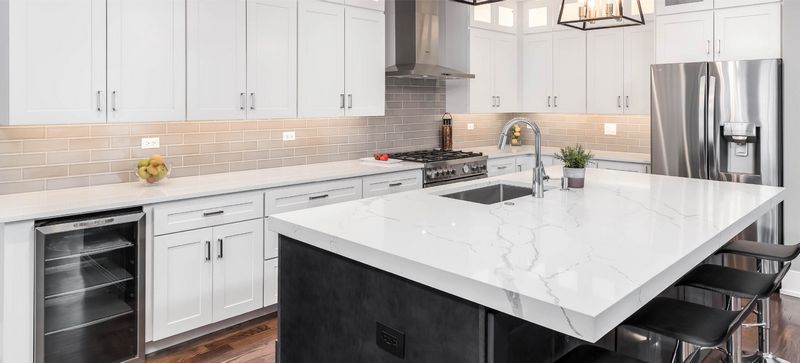
Which one should you choose?
Selecting the right surface comes down to balancing your operational habits against your aesthetic goals and budget boundaries. If you are comparing mid-tier selections, is quartz more expensive than granite in daily practice? The initial price difference between a standard $70 per sq ft granite and a $75 per sq ft quartz is negligible on a typical 40 sq ft kitchen, amounting to roughly $200 total.
To determine the best fit for your space, follow these 5 evaluation steps:
- Assess cooking style: Granite handles direct heat from heavy cast iron better, while non-porous quartz resists staining from wine, curry, and oils.
- Determine location: Choose granite for outdoor spaces or sunny areas, as UV light degrades quartz. Both excel indoors.
- Review maintenance: Quartz requires zero ongoing maintenance, whereas granite needs simple periodic resealing when water stops beading.
- Inspect full slabs: Never buy from a sample chip. Visit a local showroom to inspect full-size slabs for resin pools, natural fissures, and edge patterns.
- Get itemized estimates: Ensure quotes separate slab costs, templating, cutouts, edging, delivery, and installation to avoid hidden fees.
If your total budget is strictly capped below $2,500 for a 45 sq ft layout, entry-level granite is your best option to achieve a genuine stone surface without exceeding your limit. If you have a flexible budget of $3,500 to $5,000 and want a clean, low-maintenance look with bright white marble styling, quartz delivers the most practical performance for your investment.


