

Engineered from roughly 90% quartz and 10% resins, quartz countertops provide a non-porous, stain-resistant surface. Their glossy finish comes from factory diamond polishing rather than the liquid sealers used on natural stone. Since daily wear and chemical residues dull this shine, restoring it requires specialized techniques for engineered stone.
What makes quartz countertops look dull or faded
When homeowners observe quartz countertops not shiny in their kitchens, the culprit is rarely worn stone. Instead, visible dullness stems from surface contamination or damaged resin binders. The primary causes include:
- Product Buildup: Dish soaps and glass cleaners leave sticky residues that trap airborne grease and dust, creating a cloudy haze that masks the reflective surface.
- Hard Water Deposits: Calcium and magnesium from tap water bond tightly to the resin, leaving chalky, rough spots around sinks.
- Chemical Damage: Harsh, extreme-pH products like bleach or oven cleaners can permanently etch the polyester resin in minutes.
- Physical Abrasion: Abrasive scouring pads and harsh powders cause thousands of micro-scratches in the resin layer, which scatter light and create matte spots.
- UV Exposure: Direct sunlight photo-oxidizes the polymers over time, causing discoloration and fading.
Can quartz countertops be polished?
Unlike natural granite, which is polished using variable-speed diamond pads, crystallization chemicals, or oxalic acid, engineered quartz requires delicate handling. Because its resin binder melts around 300°F (149°C), high-speed dry buffing generates friction heat that permanently scorches the resin within seconds, leaving unfixable yellow or brown rings.
So, can quartz be polished safely at home? For broad quartz surfaces, safe polishing focuses on chemical decontamination, haze removal, and specialized micro-abrasive restorers. Mechanical polishing with diamond pads and continuous water lubrication is highly effective, but must be strictly reserved for cut edges, seams, and chipped areas.
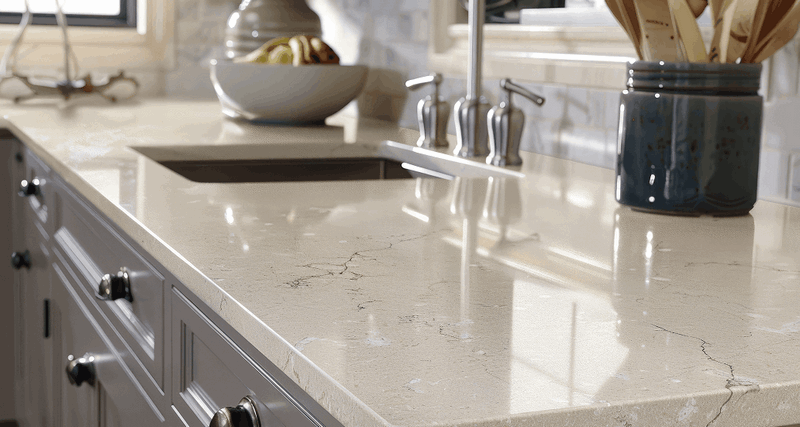
Quartz countertop polishing methods
Understanding proper surface treatment requires matching the method to the specific problem. Applying the wrong procedure can void manufacturer warranties and cause irreversible resin damage. Here is how polishing quartz countertops breaks down across three distinct approaches.
Deep chemical stripping and decontamination
This non-abrasive method removes soap scum, wax, and grease without damaging the underlying stone. Using pH-neutral degreasers, a 50/50 rubbing alcohol mix, or specialized quartz cleaners, softened deposits are gently lifted with a plastic putty knife or non-scratch sponge. It carries zero risk of resin scorching and restores gloss in roughly 80% of dull countertops.
Topical quartz surface enhancers and buffing creams
When deep cleaning isn't enough, specialized polishing compounds blend micro-wear on engineered stone. Containing micro-fine aluminum or cerium oxide, these creams are hand-buffed with a microfiber cloth to remove chemical haze and minute imperfections. They leave no artificial coating, simply smoothing resin irregularities to restore uniform light reflection.
Wet mechanical diamond pad polishing
So, can you polish quartz countertops using rotary machinery? This method is strictly for countertop edges, sink cutouts, and seams. Technicians operate a rotary wet polisher with diamond pads (50 to 3000 grit), at 2000 to 3000 rpm with continuous water flow to prevent resin burning. It must never be applied dry or to the slab's broad flat face, which causes dish marks and an uneven finish.
How to Polish quartz countertops at home
Homeowners can execute a safe restoration on dull surfaces using standard household supplies and specialized stone products. Knowing safe restoration techniques prevents costly slab replacements.
Surface preparation and deep degreasing
Before applying any polishing product, you must strip away all grease, surface oils, and mineral buildup. This foundational step is essential when learning how to make quartz countertops shine.
Equipment and supplies to assemble:
- 1 bottle of 70% or 91% isopropyl rubbing alcohol
- 1 gallon of distilled water
- 1 bottle of mild, pH-neutral dish soap
- 4 clean, lint-free microfiber towels
- 1 plastic putty knife or non-scratch nylon scouring pad
- 1 spray bottle
Procedure:
- Clear the entire countertop area of appliances, cutting boards, and dish racks.
- Mix 2 cups of distilled water with 1 teaspoon of mild pH-neutral dish soap in a spray bottle.
- Spray the entire quartz surface generously and let the solution sit for 3 min to soften dried surface debris.
- Use a plastic putty knife held at a 45° to scrape off dried paint, food glue, or hard water rings.
- Wipe the surface clean with a damp microfiber cloth.
- Mix equal parts isopropyl alcohol and distilled water in a spray bottle.
- Spray the counter completely and wipe it down with a dry microfiber cloth to dissolve remaining oils and eliminate soap scum.
Applying specialized surface restorer
Once the quartz is stripped clean, apply a dedicated quartz countertop polish formulated specifically for resin-based stone. Avoid general granite polishes that contain heavy wax, silicone, or petroleum distillates, as these attract dust and create yellow stains over time.
Steps to apply surface polish:
- Shake the quartz polishing compound bottle thoroughly for 30 sec to mix the micro-abrasive slurry.
- Pour a quarter-sized amount of polish directly onto a clean, folded microfiber cloth or a dense foam applicator pad.
- Work the product into the quartz using firm, circular overlapping motions over a 2 ft by 2 ft section.
- Maintain steady hand pressure for 60 to 90 sec per section, allowing the micro-abrasives to clear mineral scale.
- Take a second dry microfiber cloth and immediately buff the treated area vigorously before the cream dries to a crust.
- Move to the next section and repeat the process.
- Inspect the surface under angled kitchen under-cabinet lighting to confirm consistent reflection.
Edge finishing and mechanical smoothing
If you have installed a new slab, altered a cutout for a cooktop, or smoothed out a chipped corner, you need to know how to polish quartz countertops after cutting. Raw, cut quartz edges appear dull and rough, but mechanical wet polishing can fully restore their factory-matched luster.
Required Tools:
- Variable-speed wet polisher with center water feed
- Set of 4-inch wet diamond polishing pads (50, 100, 200, 400, 800, 1500, and 3000 grit)
- GFCI electrical outlet and water supply hose
- Clamps, straightedge guide, and protective gear (safety glasses, waterproof apron, ear protection)
Follow these exact steps for edge polishing:
- Secure the Slab: Fasten the quartz firmly to a heavy workbench using padded bar clamps to eliminate vibrations during polishing.
- Level the Edge (50-Grit): If saw marks exceed 1 mm in depth, attach the 50-grit pad. Set the polisher to 2000-2500 rpm with a constant water stream. Move the tool smoothly along the edge without stopping until all grooves and chips disappear.
- Dry and Inspect: Squeegee the water away, dry the edge, and confirm an even, uniform matte texture before advancing.
- Hone the Surface (100 to 400-Grit): Move sequentially through the 100, 200, and 400-grit pads using continuous wet passes. Each pad removes the scratches of the previous one, leaving a smooth honed finish by the 400-grit stage.
- Develop the Sheen (800 to 1500-Grit): Switch to the 800 and 1500-grit pads. The color pigments will darken to match the top surface, and a soft satin sheen will emerge.
- Final Polish (3000-Grit): Run the 3000-grit pad for 2 minutes per 3-foot section to polish the minerals and resin to a brilliant mirror finish. Wipe dry with a microfiber towel and inspect under direct light for missed scratches.
When polishing is not the right solution
Homeowners often search for how to polish quartz countertops, but polishing cannot fix every type of countertop defect. Because quartz countertops contain plastic resin binders, certain structural and chemical damage cannot be fixed with surface polishing. These permanent defects include:
- Heat Damage: Setting hot pans directly on the surface scorches the resin deep within the slab, causing permanent yellowing, blistering, and micro-cracking.
- Chemical Burns: Prolonged exposure to harsh chemicals like oven cleaners or acetone dissolves the resin matrix, creating pitted craters where quartz crystals have loosened and fallen out.
- UV Yellowing: Sunlight discoloration penetrates the full thickness of the slab, rendering superficial polishing completely ineffective.
- Structural Cracks: Fissures caused by foundation shifts, heavy weight, or improper leveling require professional epoxy injection, mechanical clamping, or complete slab replacement.
How to maintain a polished quartz finish
- Clean spills immediately. While quartz resists stains, highly pigmented liquids like red wine, black coffee, turmeric tea, tomato sauce, and balsamic vinegar can leave surface rings if left to dry for 12 hr.
- Use pH-neutral cleaners for daily wipe-downs. Warm tap water mixed with a few drops of mild dish soap works well, but rinse the counter with fresh water afterward to prevent soap film buildup. Alternatively, use dedicated daily quartz sprays that leave 0 residue behind.
- Never use high-alkaline or high-acid cleaning products. Avoid:
- Ammonia-based window sprays
- Bleach solutions over 5% concentration
- Toilet bowl cleaners and tile grout cleaners
- Oven cleaners and degreasers containing potassium hydroxide
- Vinegar and lemon juice mixtures left sitting on the counter
- Use cutting boards. Quartz is hard enough to dull your kitchen knives, but metal blades can leave dark gray metal transfer marks on the stone.
- Protect the surface from heat. Place silicone trivets, insulated hot pads, or wooden boards underneath slow cookers, instant pots, air fryers, and toaster ovens. These countertop appliances radiate heat downward for 4 to 8 hr continuously, which can cause heat stress fractures in the slab underneath.


