

Choosing stone surfaces for your kitchen or bathroom involves balancing aesthetics, weight, cabinet strength, and budget. Quartz is an engineered stone made of roughly 90% to 93% crushed natural quartz crystal bound with 7% to 10% polymer resins and color pigments. Because quartz slabs are manufactured rather than quarried in solid blocks, fabricators produce them to exact gauge specifications.
Getting your dimensions right prevents structural issues, unexpected cabinet modifications, and unnecessary labor expenses. A slab that is too thin can crack under heavy countertop appliances or along unsupported overhangs. A slab that is heavier than necessary adds thousands of lbs to your floor joists and raises your material costs.
Standard quartz countertop thickness options
Engineered stone manufacturers deliver slabs in two primary gauges: 2 cm and 3 cm. Slabs measuring 1 cm or 1.2 cm also exist, though fabricators reserve those ultra thin profiles for vertical wall cladding, fireplace surrounds, shower walls, and backsplashes.
Finding the standard quartz countertop thickness for your residential project comes down to your geographic region, your aesthetic goals, and whether you prefer direct cabinet placement or laminated edge profiles.
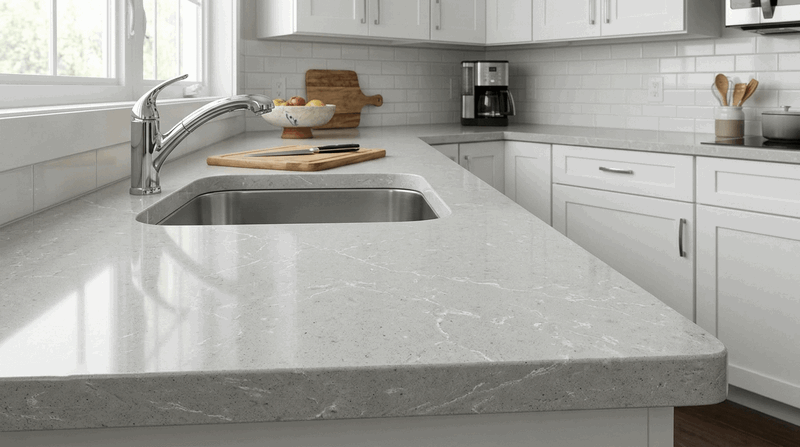
2 cm quartz countertops (3/4 inch)
A 2 cm slab measures approximately 0.78″ (rounded to ¾″) and is the dominant standard on the US West Coast and across Europe. Because it is relatively thin, installers place a ⅝″ or ¾″ plywood subtop over base cabinets to provide continuous support and prevent sagging across open spans. To conceal the underlayment, fabricators build up exposed borders with edge lamination or a 45° miter cut, creating a visual face of 1.5″ or thicker.
Advantages of 2 cm quartz:
- Weighs 10 to 12 lbs per sq ft, making transport into tight spaces easier.
- Enables seamless bookmatching on waterfall edges via miter joints.
- Allows custom drop edges that mimic monolithic, ultra-thick stone slabs.
- Costs less per raw slab unit than 3 cm stock.
- Ideal for backsplashes, shelves, and vertical wall paneling.
Disadvantages of 2 cm quartz:
- Demands full plywood underlayment on horizontal runs.
- Extra labor for edge buildups can cancel out raw slab savings.
- Supports only 6″ of unsupported overhang before requiring steel brackets.
- Offers less mechanical strength at sink cutouts during transport and dry fitting.
3 cm quartz countertops (1-1/4 inch)
A 3 cm slab measures approximately 1.18″, commonly referred to as 1¼″. This gauge is the undisputed market standard across the East Coast, Midwest, and Southern United States for residential kitchens.
The defining characteristic of 3 cm engineered stone is its structural self sufficiency. A 3 cm worktop installs directly on top of leveled cabinet boxes without plywood decking. The solid body of the slab carries its own weight across cabinet spans and delivers a clean, solid stone appearance straight off the fabrication line.
Because 3 cm material carries substantial mass, edge finishing is straightforward. When evaluating how thick is quartz countertop material for high traffic kitchens, this profile carries its own weight across cabinet spans and delivers a clean, solid appearance straight off the fabrication line.
Advantages of 3 cm quartz:
- Installs directly on top of cabinet perimeters without plywood subtops or special underlayment.
- Features solid, uniform stone edges without glue seams or lamination lines.
- Handles up to 10″ or 12″ of overhang without external corbels or steel support plates.
- Resists point impact, heavy dropped cookware, and vertical flex better than thinner profiles.
- Reduces fabrication time because shops do not need to miter or laminate perimeter edges.
Disadvantages of 3 cm quartz:
- Weighs 16 lbs to 20 lbs per sq ft, demanding flat, level, structurally sound cabinet framing.
- Carries higher freight and initial raw slab acquisition costs.
- Harder to maneuver in tight living spaces, townhomes, and high rise buildings.
- Too heavy for vertical wall cladding, upper shelving, or lightweight furniture frames.
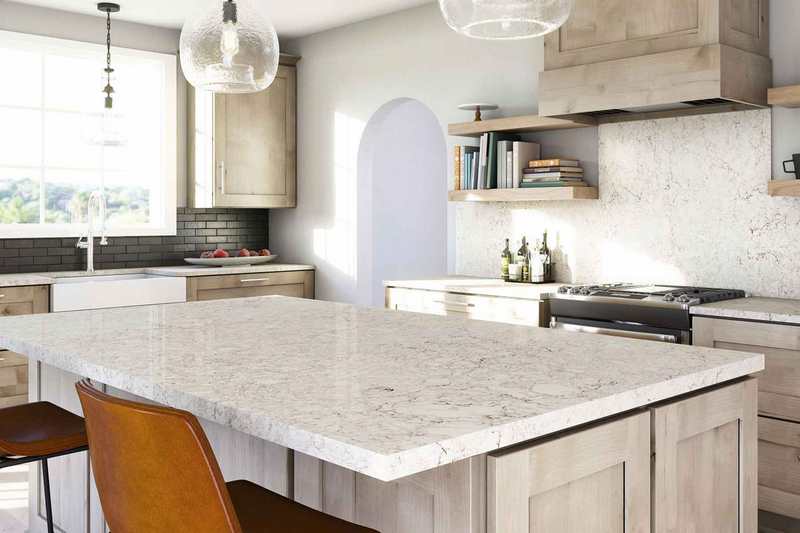
Typical countertop thickness across different materials
Every countertop surface behaves differently under stress, deflection, and weight loads. Comparing standard gauges helps homeowners see how quartz stacks up against natural stone, synthetic solid surfaces, and butcher block.
Granite and marble slabs follow the 2 cm and 3 cm convention, while porcelain and sintered stone lean heavily into ultra thin profiles engineered with extreme density. Solid acrylic materials like Corian rely on a thin ½″ skin backed by subtop frames, while butcher block requires thickness to prevent seasonal cupping and warping.
Understanding the typical countertop thickness across materials allows you to align adjacent surfaces, set correct electrical outlet heights, and specify appropriate plumbing fixtures.
Key factors that influence the thickness of a quartz countertop
Selecting slab depth is not merely a question of visual preference. Countertop fabricators assess multiple technical requirements before approving slab cuts. Evaluating the thickness of quartz countertop products requires reviewing kitchen layout geometry, cantilever projections, and daily usage patterns.
- Application and Location: Primary kitchen prep surfaces require 3 cm stone for heavy daily wear, whereas lighter-use areas (like vanities, wet bars, and powder rooms) work well with 2 cm slabs.
- Unsupported Overhangs on Islands and Peninsulas: A 2 cm slab allows overhangs of only 6″ to 8″ before requiring concealed steel supports spaced every 18″ to 24″. In contrast, 3 cm stone supports overhangs up to 10″ to 12″ without extra reinforcement, provided 70% of the slab rests are anchored on the cabinet base.
- Edge Profile Styling: Elaborate edge profiles (ogee, cove, deep bevels) need the vertical depth of 3 cm stone. Conversely, 2 cm stone provides a lighter base for mitered, laminated aprons on modern waterfall islands.
- Appliance and Fixture Coordination: Undermount sink inserts anchor securely into 3 cm stone without risk of punching through the top. A 2 cm slab often requires reinforcing sink rails or cabinet framing for adequate support.
- Overall Layout Weight on Cabinetry: While standard plywood kitchen cabinets easily handle 3 cm stone, older particleboard, repurposed furniture, or floating vanities benefit from 2 cm stone’s lighter profile.
Thickness vs. durability, performance & longevity
Engineered stone has identical surface composition across all gauges, offering equal resistance to stains, acids, and scratches. Thickness instead impacts structural deflection, edge strength, and overall durability under daily stress. Applying a strict countertop thickness standard ensures that the stone tolerates dynamic stress from household activities.
- Impact Resistance Along Edges: Undermount sink edges are vulnerable to cookware strikes. Featuring 50% more vertical mass, a 3 cm edge dissipates impact force far better than an unlaminated 2 cm edge, reducing corner fracturing.
- Flexural Rigidity and Deflection: As cabinets shift with foundation settling, stone can crack under bending stress. A 3 cm slab inherently resists bending, whereas a 2 cm slab relies on stiff plywood underlayment to avoid structural fractures.
- Thermal Shock Dissipation: Because resins degrade above 300 °F, both gauges require trivets. However, a 3 cm slab absorbs thermal gradients across a larger cross section, reducing localized expansion and thermal shock cracking near cooktops.
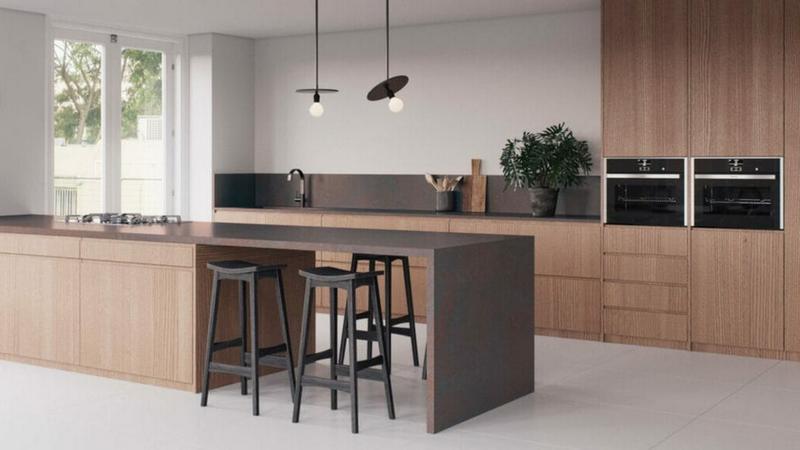
Installation considerations related to countertop thickness
Proper fabrication and installation require matching cabinet preparation to quartz countertop thickness according to these key structural guidelines:
- Base Cabinet Leveling: Cabinets must be level within ⅛″ over 10 ft. Because 3 cm stone rests directly on cabinet frames without flexing, installers use shims under cabinet corners to eliminate gaps that cause point-load fractures.
- Plywood Underlayment Construction: A 2 cm slab requires ⅝″ or ¾″ ACX plywood sub-tops attached to cabinet braces. Particleboard and MDF must be avoided, as moisture causes swelling that ruins stone joints.
- Sink and Cooktop Cutout Reinforcement: Cutouts weaken stone rails. Installers reinforce 2 cm slabs by embedding fiberglass or steel rods in epoxy underneath. For 3 cm slabs, fabricators maintain 3″ to 4″ solid stone margins and rely on cabinet-mounted sink harnesses to support heavy fixtures.
- Seam Placement and Glue Bonds: Seams must sit above cabinet dividing walls rather than open voids or dishwashers. Joined with two-part epoxy, 3 cm slabs bond along their contact edge, whereas 2 cm slabs with laminated drops require seam alignment across both the deck and vertical apron.
Cost implications of different quartz thicknesses
Engineered stone pricing includes slab material, freight, fabrication, edge profiling, and installation. Understanding how thickness affects each category prevents budget surprises.
- Slab Acquisition Costs: Wholesale 3 cm quartz slabs cost 15%–25% ($32 to $55/sq ft) more than identical 2 cm slabs ($25 to $40/sq ft) due to extra material weight and freight.
- Fabrication and Edge Profiling Labor: Although cheaper to purchase, 2 cm slabs add $15 to $35/linear ft in labor when adding mitered or laminated edges. Standard 3 cm stone requires only direct edge grinding and polishing, reducing shop labor.
- Total Installed Cost Comparison: Factoring in subtops, lamination, and labor, 2 cm counters with laminated edges closely match 3 cm counters with standard edges in final price:
- 2 cm (eased edge on plywood): $55 to $85/sq ft installed
- 2 cm (custom mitered 2″ apron): $75 to $125/sq ft installed
- 3 cm (direct mount, standard edge): $70 to $110/sq ft installed
- 3 cm (premium profiles like ogee): $80 to $130/sq ft installed


