

Selecting the right kitchen surface requires balancing daily performance, visual appeal, and total installed cost. Both engineered quartz and sintered porcelain rank among the most popular premium surfaces for modern kitchens and bathrooms.
Evaluating porcelain vs quartz countertops helps you determine which material handles your cooking habits, indoor or outdoor layout, and remodeling budget. This guide breaks down the core technical differences, pros, cons, and long-term costs of each option.
What are porcelain countertops?
Porcelain countertops are engineered slabs manufactured from kaolin clay, feldspar, silica, and mineral oxides. Manufacturers press these raw minerals under 400 bars of pressure and fire them in kilns at temperatures exceeding 2200°F. This vitrification process fuses the ingredients into a dense, non-porous slab.
Key technical specifications of porcelain slabs include:
- Standard slab thicknesses: 6 mm, 12 mm, and 20 mm.
- Water absorption rate: Less than 0.05%.
- UV resistance: 100% stable under direct solar exposure.
- Surface finish options: Polished, honed, matte, and textured stone finishes.
High-definition inkjet printing applies patterns to porcelain surfaces, accurately replicating marble, granite, concrete, and oxidized metals. Many modern slabs offer through-body veining where the pattern runs through the full thickness of the material. A porcelain countertop vs quartz provides superior thermal and chemical resistance due to its kiln-fired composition.
What are quartz countertops?
Quartz countertops are engineered stone surfaces made from 90% to 93% ground natural quartz crystals combined with 7% to 10% polymer resins and color pigments. The mixture undergoes vibro-compression under vacuum to eliminate air pockets, followed by curing in thermal ovens at 180°F to 200°F.
Key technical specifications of quartz slabs include:
- Standard slab thicknesses: 2 cm and 3 cm.
- Weight: 10 to 15 lbs per sq ft for standard 2 cm slabs, and 15 to 20 lbs per sq ft for 3 cm slabs.
- Porosity: Non-porous with zero sealing requirements.
- Edge profile flexibility: Compatible with eased, bullnose, ogee, bevel, and laminated edges.
When comparing quartz vs porcelain countertops, quartz provides structural flexibility due to its polymer resin binders. This resin network reduces brittleness during transport and fabrication, allowing installers to shape custom edge profiles with standard diamond tooling.
Head-to-head comparison: porcelain vs quartz
Durability & strength
Porcelain rates between 7 and 8 on the Mohs hardness scale. Its vitrified surface resists deep scratches, heavy gouges, and steel knife blades. Porcelain is hard, but its rigid density makes slab corners and edges brittle under direct blunt impact from heavy metal pans.
Quartz rates at 7 on the Mohs scale. The polymer resin matrix gives quartz structural flexural strength, making it less prone to edge chipping during daily impact. Quartz withstands knife contact, but dragging sharp metal or ceramic objects across the surface can leave fine scratches in the resin binder.
Appearance & design options
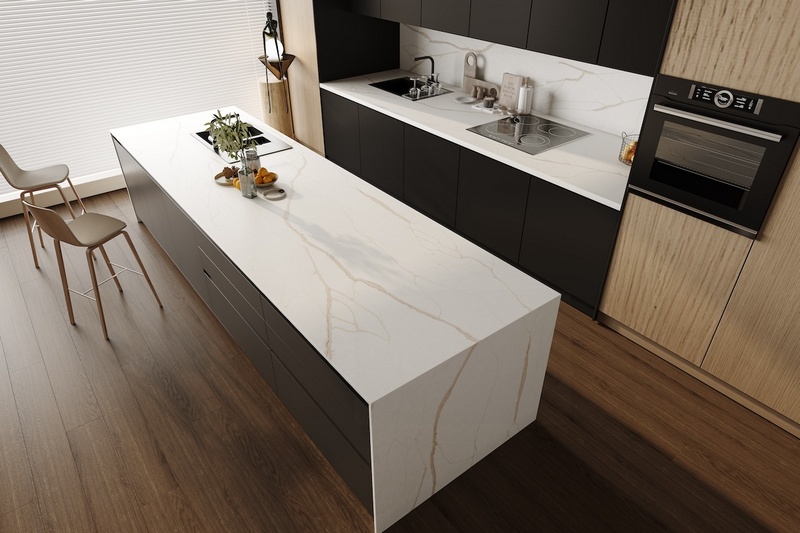
Porcelain surfaces utilize high-resolution digital glaze technology to mimic rare natural stones like Calacatta marble, travertine, and dark soapstone. Glazed porcelain delivers ultra-realistic veining, though standard 6 mm and 12 mm slabs require mitered edges to conceal the plain edge core on non-through-body designs. Fabricators can bookmatch porcelain slabs to create symmetrical, mirror-image patterns across large islands and vertical backsplashes.
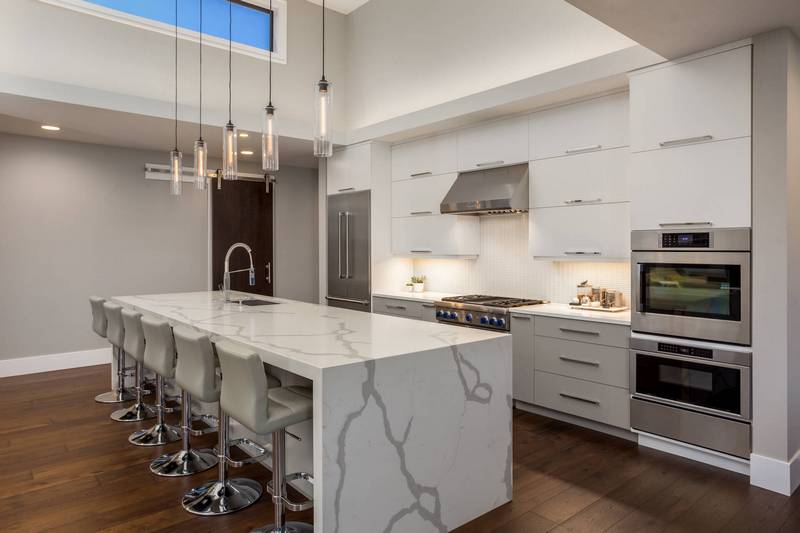
Quartz features consistent color patterns distributed across the entire body of the slab. Resin formulations enable pure solid whites, deep blacks, sparkling metallic flecks, and realistic marble veining. Because the pattern runs through the full 2 cm or 3 cm thickness, fabricators can cut rounded, beveled, or intricate edge details without exposing an unprinted interior.
Maintenance & care
Porcelain and quartz require minimal routine maintenance compared to natural granite or marble:
- Sealing: Neither material requires topical sealers or impregnating chemical treatments.
- Daily cleaning: Wipe surfaces with warm water, mild dish soap, and a microfiber cloth.
- Deep cleaning: Porcelain tolerates bleach, acetone, acidic descalers, and abrasive scrubbing pads without dulling.
- Chemical limits: Quartz degrades when exposed to highly alkaline cleaners with pH greater than 10, paint strippers, or concentrated oven cleaners.
Long-term maintenance expenses also influence the overall porcelain slab vs quartz cost, as porcelain eliminates the need for specialized stone cleaners by resisting aggressive household disinfectants.
Heat, moisture & chemical resistance
Porcelain withstands direct heat up to 1000°F. You can set hot cast iron pans, baking sheets, and boiling pots directly onto the porcelain surface without thermal shock, discoloration, or cracking. Porcelain absorbs less than 0.05% moisture and contains no petroleum-based binders, making it immune to UV fading in outdoor kitchen installations.
Quartz resists heat only up to 300°F. Placing hot cookware directly on quartz causes the polymer resins to melt, scorch, or leave permanent yellow ring marks. Always use trivets and hot pads with quartz. Quartz is moisture-proof and stain-resistant indoors, but direct outdoor UV sunlight breaks down the resin binders, causing yellowing and surface chalking within 12 to 24 months.
Hygiene & food safety
Both materials provide non-porous surfaces that prevent raw meat juices, wine, coffee, oils, and bacteria from penetrating below the top layer. Both hold NSF 51 certifications for direct food contact areas.
Porcelain offers an advantage in sanitization: you can steam-clean or apply medical-grade disinfectants directly to the slab without stripping the finish.
Cost comparison: porcelain vs quartz
Total project costs include raw slab purchases, specialized fabrication, edge profiling, cutouts, and physical installation labor.
When evaluating the porcelain countertops price vs quartz, raw material costs are comparable, but fabrication costs vary significantly.
Typical price ranges per sq ft:
- Standard quartz material: $30 to $65 per sq ft.
- Premium quartz material: $65 to $110 per sq ft.
- Quartz fabrication and installation labor: $30 to $50 per sq ft.
- Total installed quartz price: $60 to $160 per sq ft.
- Standard porcelain material: $35 to $70 per sq ft.
- Premium porcelain material: $70 to $120 per sq ft.
- Porcelain fabrication and installation labor: $45 to $90 per sq ft.
- Total installed porcelain price: $80 to $210 per sq ft.
Comparing fabrication requirements reveals that porcelain demands specialized waterjets, high-RPM bridge saws, stress-relief cutting techniques, and mitered edge assemblies. These requirements drive up contractor labor rates.
Homeowners often ask: are porcelain countertops cheaper than quartz? While entry-level porcelain slabs cost less at raw wholesale distributors, total completed installations for porcelain usually cost 15% to 30% more than quartz because fewer local shops possess certified porcelain fabrication equipment.
Pros and cons summary table
Which is better: porcelain or quartz?
Choosing porcelain or quartz countertops depends on your layout requirements, cooking habits, and installation location. Use this checklist to select the right material for your home:
- Select porcelain if you build an outdoor kitchen. Porcelain handles freezing winters, intense summer sun, and direct UV rays without color fading or cracking.
- Select porcelain if you frequently set hot pots directly on the counter. Porcelain allows you to work without trivets, hot pads, or fear of scorch marks.
- Select quartz if you want extensive edge profile choices. The 2 cm and 3 cm solid slab depth supports ogee, bullnose, and custom beveled edges without requiring mitered seams.
- Select quartz if your kitchen experiences high-impact daily use. Homes with active children benefit from the impact-absorbing resins in quartz, which lower the risk of perimeter chipping.
- Select quartz if you have a strict installation budget. Lower fabrication labor and widespread local contractor availability make quartz the more accessible choice for most interior remodels.


