

Natural marble remains a benchmark for luxury in interior design. When planning a kitchen remodel or bathroom upgrade, selecting the right slab is only half the decision. The surface finish directly shapes how the stone reflects light, conceals everyday wear, resists staining, and responds to daily cleaning routines.
The debate between honed and polished marble centers on aesthetics, maintenance tolerance, and functional demands. Both finishes originate from identical natural stone slabs quarried from the earth. The processing technique applied by stone fabricators creates two distinctly different appearances and performance profiles.
Understanding these mechanical differences helps homeowners, builders, and designers make an informed investment. Whether you want a high-glaze traditional aesthetic or a muted contemporary feel, choosing the right finish ensures your marble surfaces age gracefully over decades.
What does “Honed” mean?
Homeowners often ask what does honed mean when exploring custom natural stone options. In stone fabrication, honing refers to a mechanical grinding process that creates a smooth, flat, non-reflective surface finish.
Fabricators use high-speed industrial rotary discs coated with diamond abrasives. During the honing process, the stone passes under coarse abrasives, starting around 60 to 120 grit. The process advances through progressively finer grits, typically concluding between 220 and 400 grit. Grinding stops before the abrasives generate enough friction to produce a high-gloss sheen.
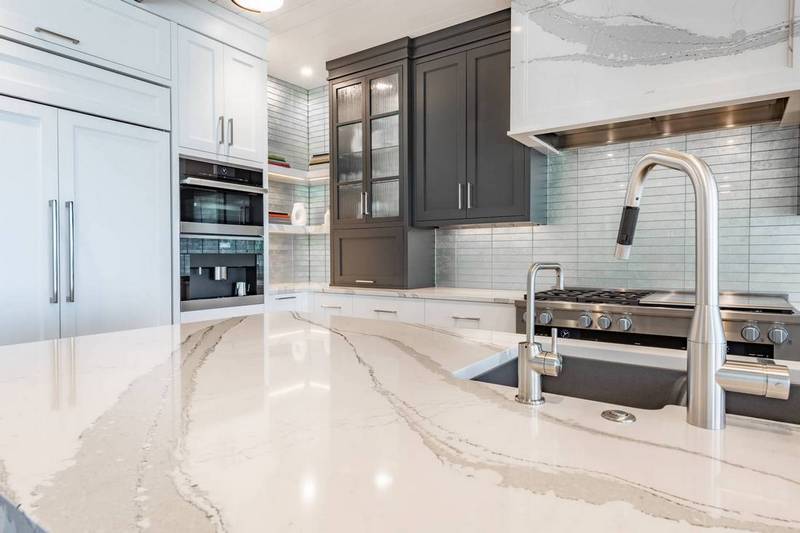
The result is a soft, satin-like surface with a velvety tactile feel. A honed surface diffuses light across the room rather than reflecting it directly. This matte quality creates an understated, organic look popular in modern, transitional, and European architectural designs.
Because the honing process stops before the micro-pores of the stone seal through high friction, a honed slab retains open surface pores. This open structure influences how the marble absorbs sealers, repels oils, and hides superficial scratches from daily activity.
What is honed marble countertops?
When fabricators produce marble countertops, they create a surface specifically engineered to disguise everyday kitchen wear. The natural composition of marble consists predominantly of calcium carbonate CaCO3.
This mineral structure reacts chemically with acidic substances such as lemon juice, wine, tomato sauce, and vinegar. This reaction, known as etching, removes the top layer of stone and leaves a dull mark.
To understand what is honed marble in terms of performance, one must look at how light interacts with surface damage. Because a honed finish is already dull and matte, acid etch marks blend into the background texture. An etch mark on a honed slab appears far less noticeable under direct overhead lighting compared to the same mark on a glossy surface.
Key advantages of honed marble surfaces include:
- Superior concealment of chemical etch marks caused by acidic liquids
- Reduced visibility of micro-scratches, dust, and daily wear patterns
- Soft, tactile texture that adds warmth to kitchen islands and bathroom vanities
- Elimination of sharp glare from recessed ceiling fixtures and pendant lights
Honed marble works exceptionally well in busy household kitchens where daily cooking makes total acid avoidance impossible. The matte profile delivers an authentic, aged patina over time, evoking the classic look of European bakeries and historical estates.
What is polished marble countertops?
Polished marble represents the classic, luminous finish associated with traditional luxury and formal architecture. When stone professionals polish marble countertop slabs, they continue the abrasive grinding process well past the 400 grit stage.
Fabricators run slabs under ultra-fine diamond polishing pads ranging from 800 to 3000 grit. The final stage uses polishing compounds containing tin oxide or aluminum oxide along with heavy felt buffing wheels. This mechanical friction closes the microscopic surface pores and creates a smooth, mirror-like gloss.
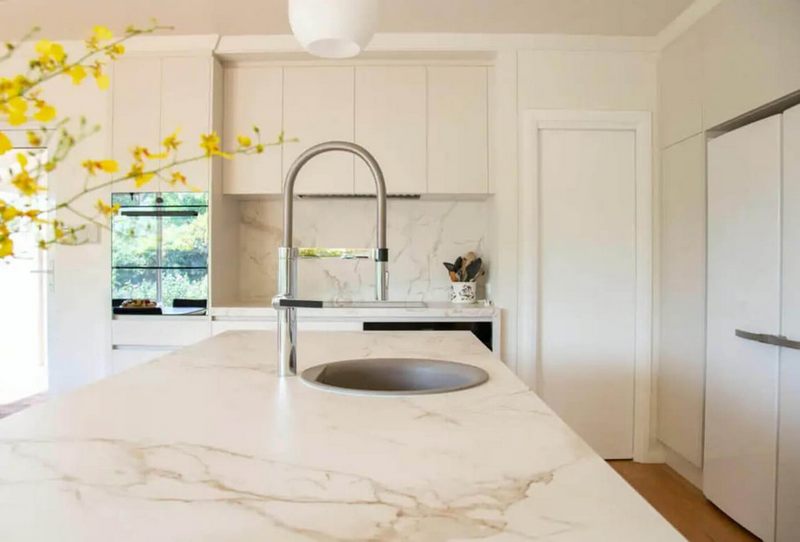
The high-gloss finish acts as an optical amplifier for the natural veining, crystals, and subtle mineral shifts inside the stone. Dark marbles like Nero Marquina or richly veined varieties like Calacatta Gold display greater depth and color saturation when polished.
The buffing process tightens the surface structure, providing a short-term natural barrier against liquid penetration. Polished marble resists liquid staining slightly better than raw honed marble. However, the high-gloss surface acts like a mirror, making any surface disruption instantly visible. Acidic spills chemically alter the gloss, turning bright spots into flat, dull patches that stand out against the surrounding sheen.
Honed vs. Polished marble countertops: key differences
Choosing between these 2 surface treatments requires evaluating how each performs across durability, maintenance, optical clarity, and cost. While both finishes share the same structural density, their surface physics produce different results.
Understanding the difference between honed and polished marble prevents costly maintenance mistakes and ensures realistic expectations for daily use.
Evaluating honed vs polished marble countertops involves comparing 5 primary performance categories:
- Optical Reflection and Color Tone: Polished marble enhances contrast. The crystalline structure beneath the surface reflects focused light, making white backgrounds brighter and grey or gold veins sharper. Honed marble softens these contrasts, shifting the overall color palette toward muted, pastel tones.
- Chemical Etching vs. Liquid Staining: A common misconception confuses etching with staining. Staining occurs when pigmented liquids (like coffee or oil) penetrate the stone pores and change its color. Etching is chemical physical damage caused by acids eating away the calcite surface. Honed marble resists the appearance of etching while remaining more vulnerable to deep stains. Polished marble resists liquid penetration better but shows acid etching immediately.
- Scratch and Abrasion Resistance: Marble rates around 3 to 4 on the Mohs mineral hardness scale. Metal utensils, ceramic dish bases, and heavy cookware can scratch both finishes. On polished marble, scratches create white fracture lines that disrupt light reflection. On honed marble, minor abrasions blend smoothly into the satin surface.
- Slip Resistance for Wet Areas: Honed finishes provide greater traction underfoot because the open surface texture increases friction. For walk-in shower pans, bathroom floors, and outdoor pool surrounds, honed stone offers significantly better slip resistance than slick polished surfaces.
- Fabrication and Refinishing Costs: Standard polished slabs are the default factory finish from most international quarries. Slabs ordered with a custom honed finish occasionally carry a modest fabrication upcharge of $10 to $20 per sq ft depending on the supplier.
Which one should you choose: honed or polished marble
The decision between honed vs polished marble depends on your lifestyle, cooking habits, and interior design goals. Neither option is universally superior; each solves specific functional and aesthetic challenges.
Choose honed marble if:
- Your kitchen island serves as a primary food preparation hub for a busy household.
- You prefer modern, rustic, Scandinavian, or transitional design styles.
- Your kitchen receives intense natural light that would create annoying reflections on glossy stone.
- You appreciate natural aging and want a surface that develops a lived-in character.
- You are installing marble on bathroom floors or shower areas where slip prevention is critical.
Choose polished marble if:
- You want a dramatic focal point in a formal dining room, powder room, or fireplace surround.
- You prefer bold color contrast that highlights complex mineral patterns.
- You are willing to use cutting boards, coasters, and immediate cleanup routines to avoid acid contact.
- Your room lacks abundant natural light and needs reflective surfaces to brighten the space.
- You prioritize stain resistance against colored liquids over etch concealment.
Use this 4-step process to evaluate your space before placing a slab order:
- Examine your lighting layout. Count your ceiling fixtures, under-cabinet LEDs, and natural window openings. High-output spotlights can produce uncomfortable glare on polished slabs.
- Review your cooking routines. If your household regularly works with citrus, tomato sauce, red wine, and vinegar, a honed finish reduces maintenance stress.
- Order 12 in by 12 in physical tile samples of both finishes in your chosen marble variety.
- Run testing on both samples. Pour 1 drop of lemon juice, 1 drop of olive oil, and 1 drop of red wine on each piece. Let them sit for 15 min, wipe clean, and observe the visible change in normal room lighting.
How to care for honed and polished marble
Proper maintenance preserves the beauty of natural stone regardless of the surface treatment. Establishing a consistent care routine protects your investment against permanent discoloration and accelerated wear.
Daily Cleaning Protocols
Never clean natural marble with standard household sprays, bleach, ammonia, vinegar, or citric acid cleaners. These solutions cause instant chemical etching across both finishes.
- Use warm water paired with a microfiber towel for everyday wipe-downs.
- Apply a specialized pH-neutral stone cleaner with a pH level between 7 and 8 for grease removal.
- Dry the surface completely with a clean towel after washing to prevent mineral deposits from hard water.
Sealing Best Practices
Sealers do not make marble waterproof or acid-proof. High-quality penetrating sealers soak into the stone pores and deposit fluorochemical resins that slow down the absorption rate of water and oils.
- Honed marble countertops require sealing every 3 to 6 mo due to its open pore structure.
- Polished marble requires sealing every 6 to 12 mo.
- Test your seal integrity using the water drop test. Place 1 tablespoon of water on the surface and let it rest for 10 min. If the stone darkens underneath the puddle, liquid is penetrating the pores, indicating the slab requires immediate resealing.
Managing Stains and Scratches
When stains or surface damage occur, targeted treatments restore the stone without requiring full surface replacement:
- Oil-based stains: Apply a paste made from baking soda mixed with water to form a poultice with the consistency of peanut butter. Spread a 1/4 in thick layer over the stain, cover with plastic wrap, tape down the edges, and allow it to dry for 24 hrs. The powder draws the oil out of the pores through capillary action.
- Organic stains (coffee, tea, fruit juice): Use a poultice prepared with 12% hydrogen peroxide mixed with diatomaceous earth or unbleached flour.
- Minor scratches on honed marble: Gently buff the damaged area using a fine abrasive scrub pad (such as a 400 grit diamond hand pad) with light pressure and plenty of water.
- Etch marks on polished marble: Use a specialized marble polishing powder containing potassium oxalate. Buff the area with a damp microfiber cloth until the glossy shine returns.


